


GST Return Filing Work in Noida
2026-10-04T18:43:40  read more
 read more


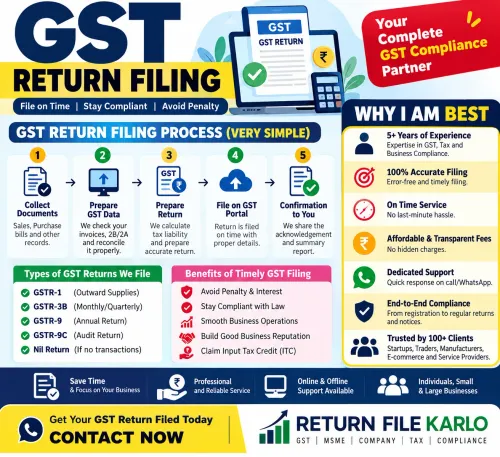
GST Basics : Complete Guide to Goods and Services Tax (GST) Introduction to GST as below : Goods and Services Tax (GST) is a comprehensive, multi-stage, destination-based indirect tax system implemented in India on 1st July 2017. It replaced multiple cascading taxes such as VAT, Service Tax, Excise Duty, and others, creating a unified tax structure across the country. GST is designed to eliminate tax-on-tax (cascading effect) and ensure seamless flow of input tax credit across the supply chain. Key Features of GST 1. One Nation, One Tax , ease of doing business GST has unified India into a single market by replacing multiple indirect taxes with a single tax system. 2. Destination-Based Tax Tax is levied at the place of consumption rather than the place of origin. 3. Input Tax Credit (ITC) Businesses can claim credit for the tax paid on purchases, reducing the overall tax burden. 4. Digital Compliance GST is fully online, including registration, return filing, and payment, ensuring transparency and efficiency. Types of GST in India GST is divided into four components: CGST (Central GST) – Collected by the Central Government SGST (State GST) – Collected by State Governments IGST (Integrated GST) – Applicable on inter-state transactions UTGST (Union Territory GST) – Applicable in Union Territories GST Registration GST registration is mandatory for businesses exceeding the prescribed turnover limits: ₹40 lakhs (goods) – Normal states ₹20 lakhs (services) ₹10 lakhs – Special category states Who Must Register Under GST? E-commerce sellers Interstate suppliers Casual taxable persons Input service distributors Businesses under reverse charge GSTIN Structure GST Identification Number (GSTIN) is a 15-digit unique number: First 2 digits – State code Next 10 digits – PAN 13th digit – Entity number 14th digit – Default “Z” 15th digit – Check code Input Tax Credit (ITC) ITC is the backbone of GST. Conditions to Claim ITC: Possession of tax invoice Goods/services received Supplier has filed returns Tax has been paid to government GST Returns Businesses must file periodic returns: GSTR-1 – Details of outward supplies GSTR-3B – Summary return with tax payment GSTR-9 – Annual return GST Payment Mechanism GST payment is made through: Electronic Cash Ledger Electronic Credit Ledger Tax liability can be adjusted using ITC as per GST rules. Advantages of GST Eliminates cascading tax effect Simplifies tax structure Boosts ease of doing business Enhances tax compliance Promotes transparency Common Challenges in GST Frequent law changes Technical portal issues Compliance burden for small businesses ITC mismatches Conclusion GST is a transformative tax reform that has streamlined India’s indirect taxation system. Understanding its fundamentals is essential for businesses, professionals, and students to ensure compliance and optimize tax benefits.
 read more
  read more
 We hate spam too.


